Why Billing Transparency Is the Hidden Trust Lever in Every SaaS
Billing escalations don't escalate because of the original error — they escalate because of the response gap. Here's the structured fix.
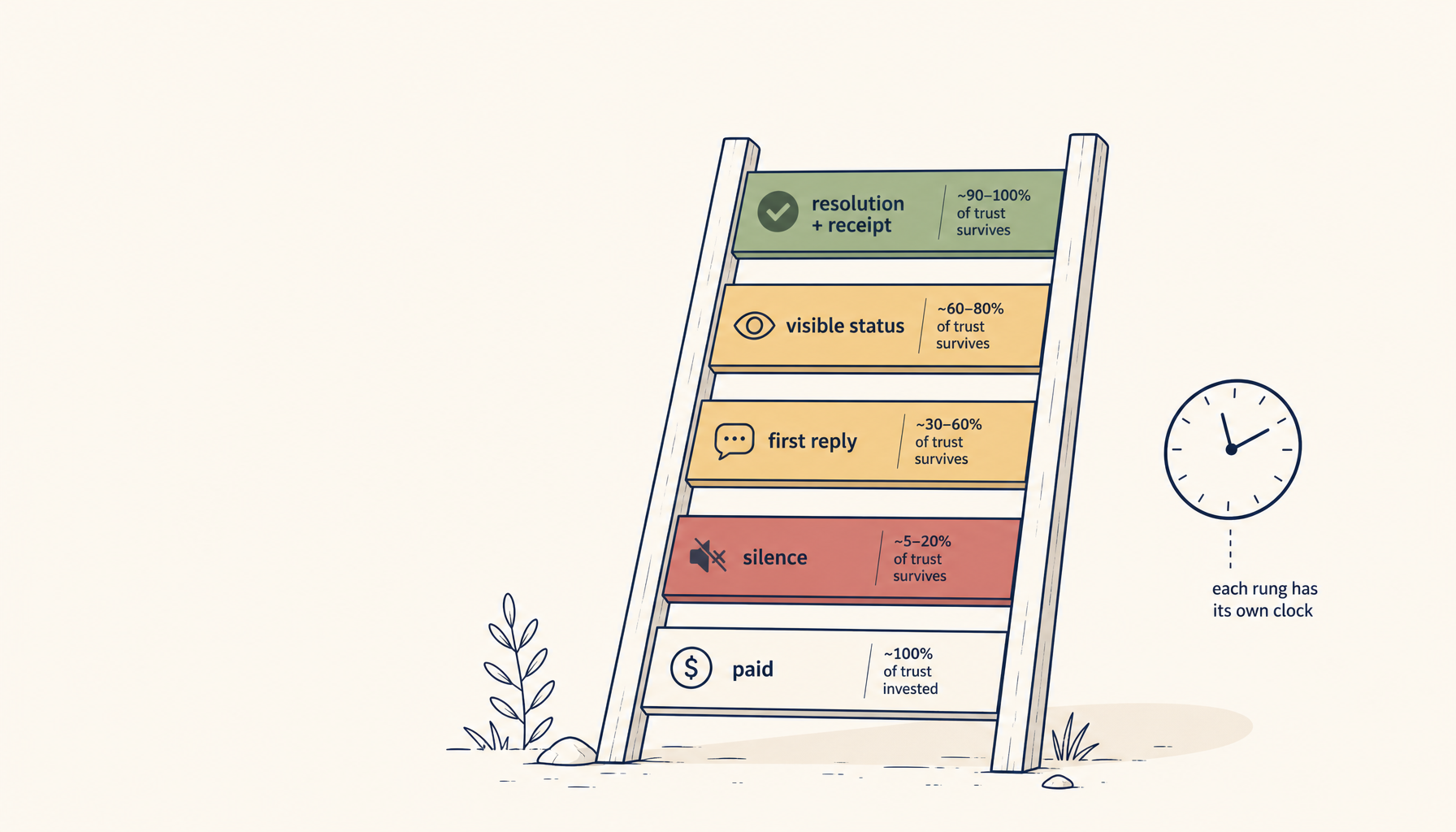
When users hit a billing problem with a SaaS tool, they don't just get frustrated. They lose trust — fast.
The pattern is consistent across support threads on Reddit, Discord, and HackerNews: a user pays, the plan doesn't activate, they email support, no reply for 24 hours, they post publicly. By hour 48 the thread has 30 comments and other users are sharing their own billing horror stories.
The fix is not "respond faster." The fix is removing the ambiguity that pushes users into the public escalation in the first place.
What "billing transparency" actually means
Billing transparency is not a marketing claim. It's a set of concrete UI affordances and support behaviors that answer four questions a user is asking, in this order:
- Did my payment succeed?
- Is my plan active?
- What features should I have access to right now?
- If something is wrong, who is fixing it and when?
Most SaaS billing UIs answer 1 well, answer 2 ambiguously, and don't answer 3 or 4 at all.
The four signals every billing surface needs
1. Payment status — receipt-grade detail
After checkout, show:
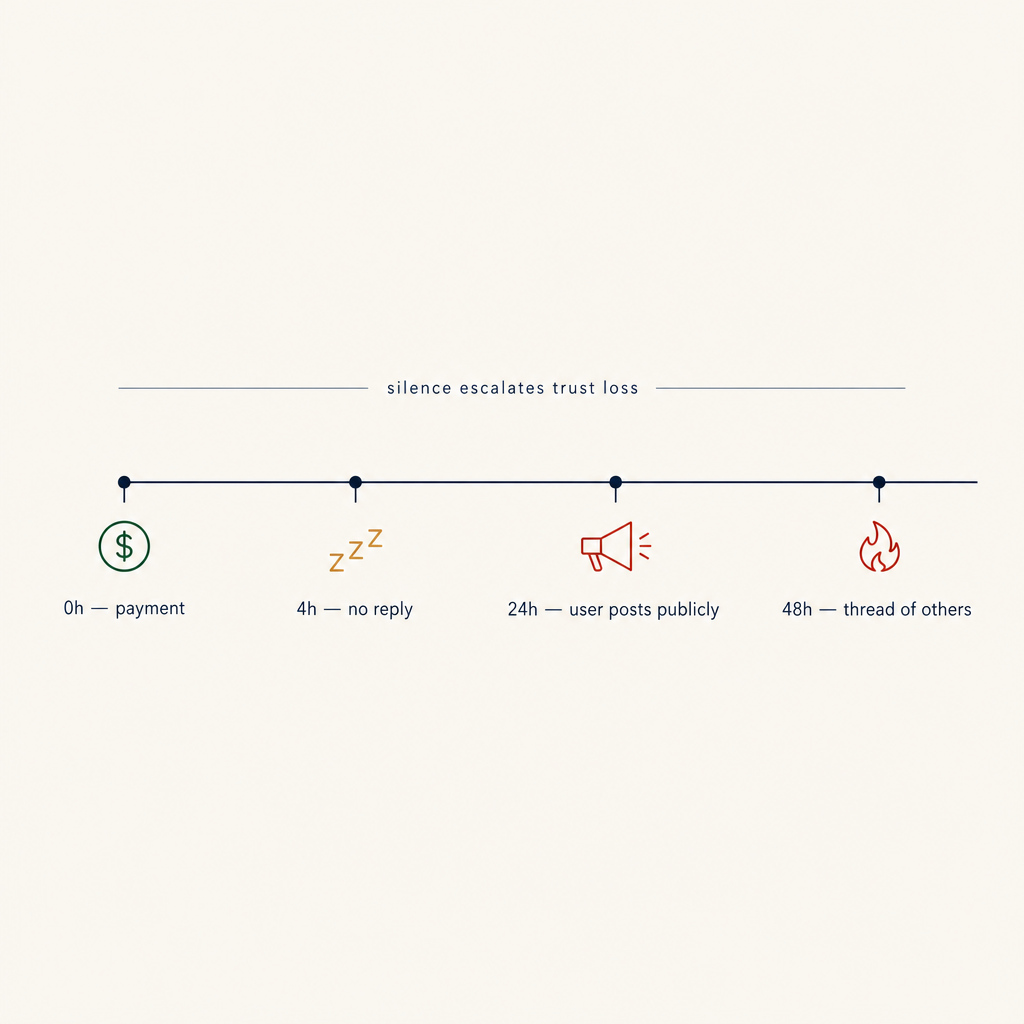
Most billing escalations are silence-driven, not money-driven. Tracking these clocks costs nothing; ignoring them costs the brand.
- The exact amount charged
- The card last 4 digits
- The transaction ID
- A "download receipt" button
- The next billing date if applicable
Email the same content as a PDF within 60 seconds. Stripe and Lemon Squeezy do this automatically — surface it in your own UI too, don't make users dig through email.
2. Plan provisioning state — not just "Pro"
The badge that says "Pro" is not enough. Show:
- The plan name
- The activation date
- The features unlocked (with checkmarks against the list)
- Any limits (seats, devices, API calls)
If provisioning is async (webhook-driven), show a real loading state with an estimated time. "Activating your plan… typically takes under 60 seconds. If it's been longer than 5 minutes, [contact us]."
3. Feature gate explanations
When a user clicks a Pro feature on Free, the modal shouldn't just say "Upgrade." It should say:
- What this feature does (one sentence)
- What plan unlocks it
- What they get total when they upgrade
Same modal language regardless of which feature triggered it. One canonical Pricing/Plans modal, multiple entry points.
4. Support escalation paths — visible, not hidden
In the billing UI, surface:
- A "Contact billing support" link with a pre-filled subject including the user's plan and email
- Expected response time (under 4 hours? 24 hours? 1 business day? Be specific.)
- A status page link if you have one
If a user has a billing question, they should never have to dig through your help center to find your support email.
The escalation template
When a user reports a billing issue, the support reply should always include these fields, in this order:
Subject: [Billing] {your-issue} — ticket #1234

Hi {name},

Thanks for reaching out. I see your situation:

- Email on file: {email}
- Last payment: {amount} on {date}, transaction {id}
- Current plan in our system: {plan}
- Plan you expected: {expected_plan}

Status: {investigating | identified | resolved}

What I'm doing right now:
{specific action — "I'm checking the webhook logs", "I've reactivated your plan", etc.}

Next update from me: {time}.

If you need an immediate workaround: {workaround if any}.

— {agent name}
The structure matters more than the words. Five fields:
- The user's situation, restated factually
- The current state in your system
- What you're doing about it
- When you'll update them next
- A workaround they can use right now
The "next update" line is the single most important sentence. It converts an open-ended anxiety ("when will this be fixed?") into a closed loop ("they'll write me back at 4 PM").
Why this works
Most billing escalations don't escalate because of the original error. They escalate because of the response gap between "user is anxious" and "support engages." During that gap the user is constructing worst-case scenarios and posting them publicly.
The template above doesn't fix the underlying bug. It closes the gap. The user knows you've seen the issue, that someone is on it, and exactly when they'll hear back. Public threads stop forming because the user has nothing to escalate.
The cheap audit
Run this once a quarter:
- Pull the last 50 billing support tickets.
- Bucket them by root cause: payment processor failure, webhook drift, manual plan changes, refund requests.
- For each bucket >5 tickets, ask: "could a UI affordance prevent the user from filing this ticket?"
Webhook drift (payment cleared but plan didn't activate) usually accounts for 60% of billing tickets. Adding a "If your plan didn't activate, click here to retry provisioning" button on the billing page eliminates most of them. The user retries the webhook themselves and the ticket never gets filed.
Trust isn't built by perfect billing infrastructure. It's built by predictable handling when billing infrastructure misbehaves — which it always does, eventually.
Related in the StoicSoft network
If you regularly stitch together PDF, image, video, or batch-file workflows like the ones above, 1FileTool is the StoicSoft network's purpose-built desktop app — 245+ local-first tools, pay-once, files never leave the device.
From across the StoicSoft network
Hand-curated reads on the same topic from sister sites in the StoicSoft family.
