The Planner-to-Executor Handoff Format That Keeps Multi-Agent Coding Work on Track
When planning and implementation blur together, quality drops. A compact handoff format keeps multi-agent coding work scoped, testable, and recoverable.
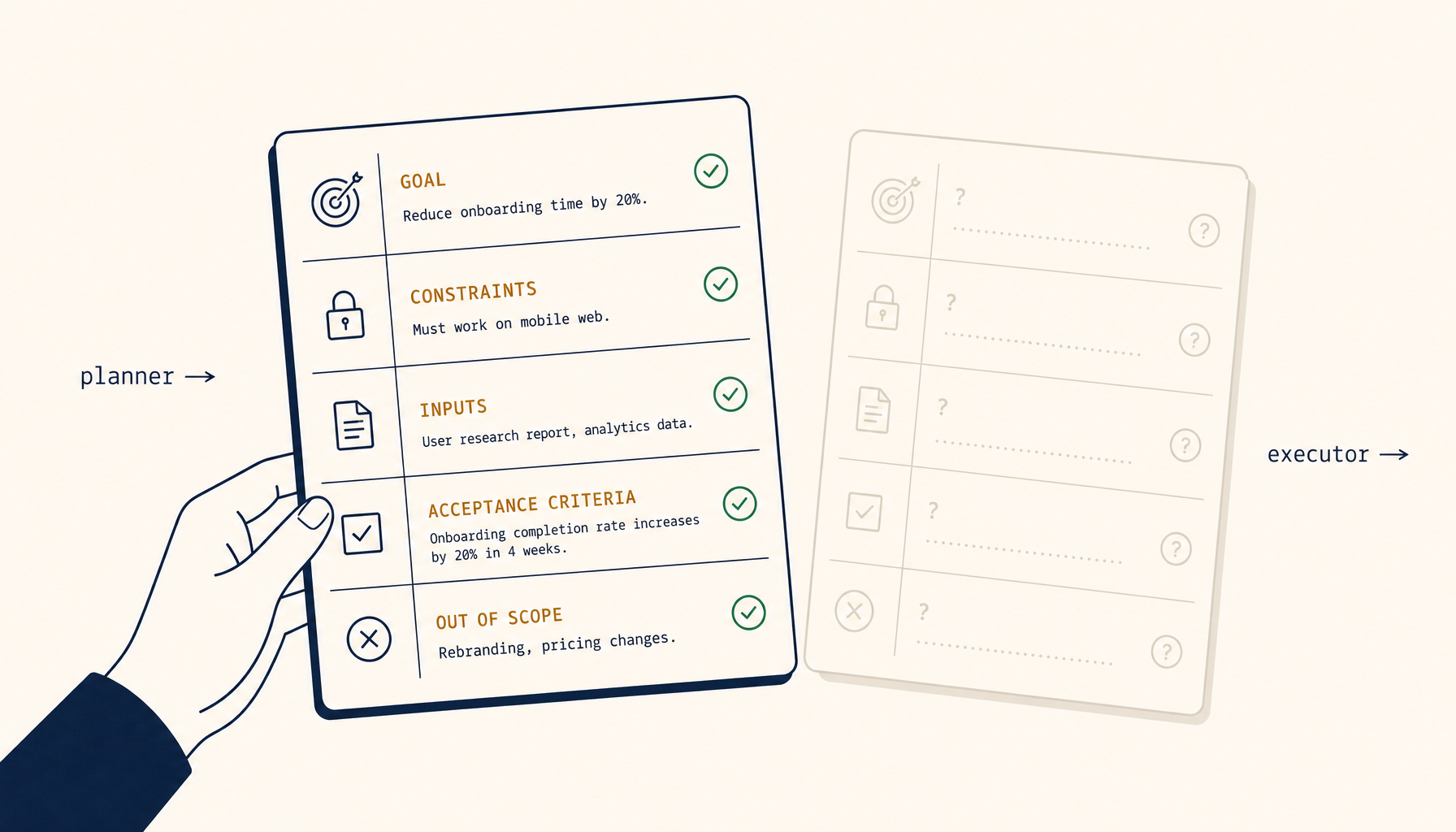
Multi-agent coding workflows usually do not fail because the model is weak. They fail because the handoff is vague.
One agent explores, one agent plans, one agent writes code, and another may verify. That sounds efficient until the executor starts guessing what the planner meant, or the verifier discovers the task quietly changed halfway through execution. At that point the workflow is not parallelised. It is fragmented.
The fix is not a longer prompt. It is a standard handoff format.
A good handoff turns the planner's output into an execution contract. The executor should be able to read it in under a minute and know four things immediately:
- What outcome matters.
- What is in scope.
- How success will be verified.
- What must not change.
If any of those are missing, the executor fills the gap with assumptions. Most expensive agent mistakes start there.
Why planner and executor work drift apart
In real workflows, drift usually comes from one of five places:
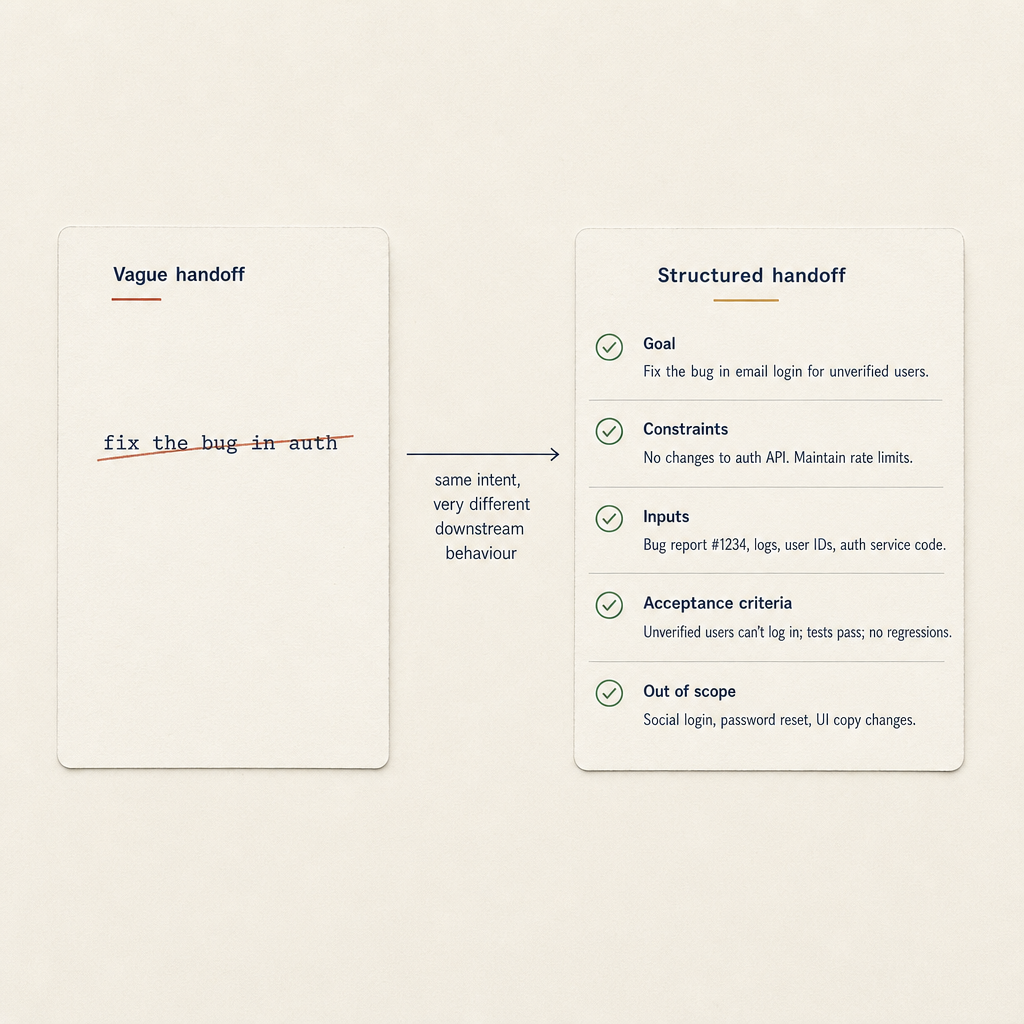
Most multi-agent failures are handoff failures. The handoff is the contract; without one, every agent is a different lawyer.
- The planner describes the problem but not the deliverable.
- The planner names files but not the allowed change boundary.
- The executor finds something adjacent and helpfully expands scope.
- Verification is implied instead of specified.
- The handoff contains observations, but not a decision.
Humans survive vague handoffs because they ask follow-up questions. Agents can ask too, but most teams using planner or executor flows are trying to reduce back-and-forth. If the handoff is underspecified, you get one of two bad outcomes:
- The executor stops too early and returns a partial fix.
- The executor keeps going and produces a sprawling diff nobody wanted.
A standard format avoids both.
The minimum viable handoff
The handoff does not need to be long. It needs to be complete.
Use this shape:
Goal:
One sentence describing the exact outcome.

Why now:
One sentence describing the bug, task, or user-facing consequence.

Files in scope:
- path/to/file-a
- path/to/file-b

Out of scope:
- No schema changes
- No new dependencies
- No unrelated refactors

Current state:
- What was inspected
- What was observed
- What seems to be causing the issue

Required change:
- Concrete action 1
- Concrete action 2

Verification:
- Run this test
- Check this route
- Confirm this output

Done criteria:
- The bug no longer reproduces
- The regression test passes
- No files outside scope changed

Open questions:
- Anything uncertain that the executor should stop and escalate on
That is enough structure for most coding tasks.
What each section is doing
Goal
The goal is not look into auth. It is return 400 with password_required when password is missing from POST slash login. The executor needs an observable result, not a topic area.
Why now
This stops tasks from turning into abstract cleanups. A handoff tied to a concrete failure state produces tighter execution than one tied to a general feeling like the auth flow seems messy.
Files in scope
This is the highest-leverage line in the template.
Scope is where most agent costs get controlled. When you name two exact files, the executor knows the search area is bounded. When you say the login flow, you are effectively authorising a repo walk.
Out of scope
This prevents cleverness.
Executors often find related issues. That is not always useful. Explicitly saying no schema changes or no refactor tells the executor to resist side quests, even if they look attractive.
Current state
This section should contain evidence, not theory.
Bad:
- Auth is probably failing because validation is weird.
Good:
- Reproduced a 500 when password is undefined.
- Stack trace points at bcrypt compare receiving undefined.
- Existing tests do not cover missing-password input.
The executor should inherit the investigation, not repeat it.
Required change
This converts diagnosis into action.
Examples:
- Add an early guard for missing password before bcrypt call.
- Add a regression test for missing password input.
- Keep response shape consistent with existing 400-level auth errors.
The executor can still choose implementation details, but the intended move is clear.
Verification
Verification is where most weak handoffs collapse.
Make sure it works is not a check. It is a wish. Verification should be operational:
- Run the auth test file.
- Send a login request without password and expect 400.
- Confirm no snapshots changed outside auth tests.
If verification is not explicit, the executor tends to over-test or under-test. Both waste time.
Done criteria
This is different from verification.
Verification says what to run. Done criteria says what finished looks like. That matters because an executor can pass a test while still violating the spirit of the task, for example by changing five extra files or introducing a config dependency.
Open questions
This is the stop-sign section.
Examples:
- If fixing this requires schema migration, stop and escalate.
- If the issue reproduces only in staging and not locally, stop after logging findings.
- If more than three files need edits, stop and ask for approval.
Without explicit stop conditions, agents tend to keep improvising.
A worked example
Here is a full handoff for a realistic task:
Goal:
Fix the 500 on POST slash login when password is missing; return 400 with error password_required.

Why now:
Support reproduced the bug in production and users hit a blank error state instead of a validation response.

Files in scope:
- src/api/auth.ts
- src/api/auth.test.ts

Out of scope:
- No schema changes
- No logger changes
- No edits outside auth route and its direct test file

Current state:
- Reproduced locally with missing-password request body.
- Stack trace points to bcrypt compare receiving undefined.
- Existing tests cover wrong password but not missing password.

Required change:
- Guard missing password before bcrypt compare.
- Return existing 400-style auth error shape.
- Add regression test covering missing password.

Verification:
- Run the auth test file.
- Confirm POST slash login without password returns 400.
- Confirm valid password still returns 200.

Done criteria:
- Missing-password case no longer returns 500.
- Regression test passes.
- No files outside scope are changed.

Open questions:
- If auth middleware shares the same bug elsewhere, note it but do not expand scope.
An executor can act on that immediately.
What not to include
A lot of handoffs get worse because the planner includes everything they know.
Avoid:
- Full terminal transcripts unless one line is decisive.
- Ten candidate fixes when one is already preferred.
- Broad repo summaries.
- Repeated rationale in multiple sections.
- Ambiguous phrases like clean this up while you are here.
The handoff is not a diary. It is a dispatch.
When to hand off versus keep work with one agent
Not every task needs a planner and executor split.
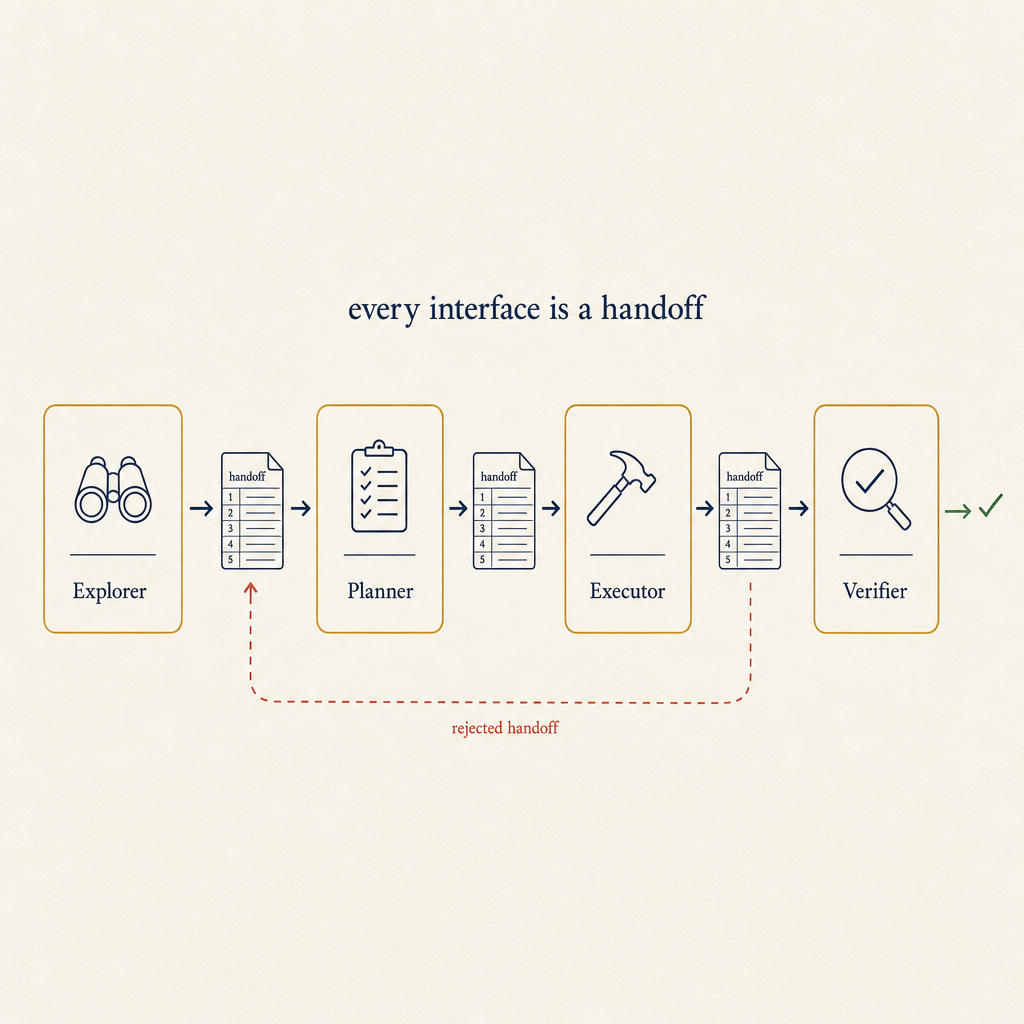
The handoff format isn't planner-only. Every agent boundary is a place where structure beats prose.
Use a handoff when:
- The problem required investigation before implementation.
- The execution phase should be tightly bounded.
- You want a reviewer or verifier to audit the intended scope.
- The cost of a wrong change is higher than the cost of one extra planning step.
Skip the split when:
- The task is tiny and obvious.
- The same person or agent already has all the necessary context.
- The verification step is trivial.
The point is not to force ceremony. It is to remove ambiguity when ambiguity is expensive.
The management benefit teams miss
A standard handoff format is not just an agent prompt improvement. It is an operating model improvement.
Once teams adopt one template, they get:
- Faster reuse of good planning patterns.
- Easier review of whether a task was scoped correctly.
- Better postmortems when a run goes wrong.
- Lower cost, because executor runs spend less time rediscovering context.
You can even audit failed runs by asking which section of the handoff was missing or weak.
Most of the time, the answer is scope, verification, or stop conditions.
Closing principle
Planner and executor workflows do not need more intelligence nearly as much as they need clearer contracts.
A strong handoff is short, concrete, and testable. It gives the executor enough context to act without giving them permission to wander.
That is the bar: not did the planner think hard, but could a different agent execute this cleanly on the first pass. If the answer is yes, the format is doing its job.
Related in the StoicSoft network
If you work in AI-assisted coding, shared terminal sessions, or agent-driven shell workflows like the ones above, 1devtool is the StoicSoft network's tool for safer AI-assisted terminal work — shared sessions with auditing, preflight policy, and tiered model routing built in.
From across the StoicSoft network
Hand-curated reads on the same topic from sister sites in the StoicSoft family.
- 1FileTool5 min read
Watch Any Folder. Process Files as They Arrive.
The Folder Monitor watches any folder and automatically applies a tool to every new file — compress, convert, strip metadata — in the background, without you having to touch the tool each time.
Read on 1filetool.com  1FileTool5 min read
Edit PDFs Visually and Save Your Tool Settings as Presets
1FileTool now has a visual PDF editor — see pages as you rearrange, annotate, and watermark. Plus tool presets: save your settings once and apply them in one click, across every tool.
Read on 1filetool.com